
Last updated September 20, 2026
Free on-site gate assessment - hinges, posts, and your LiftMaster or Nice gate operator checked before anything is quoted
The assessment is free and the quote is the invoice.

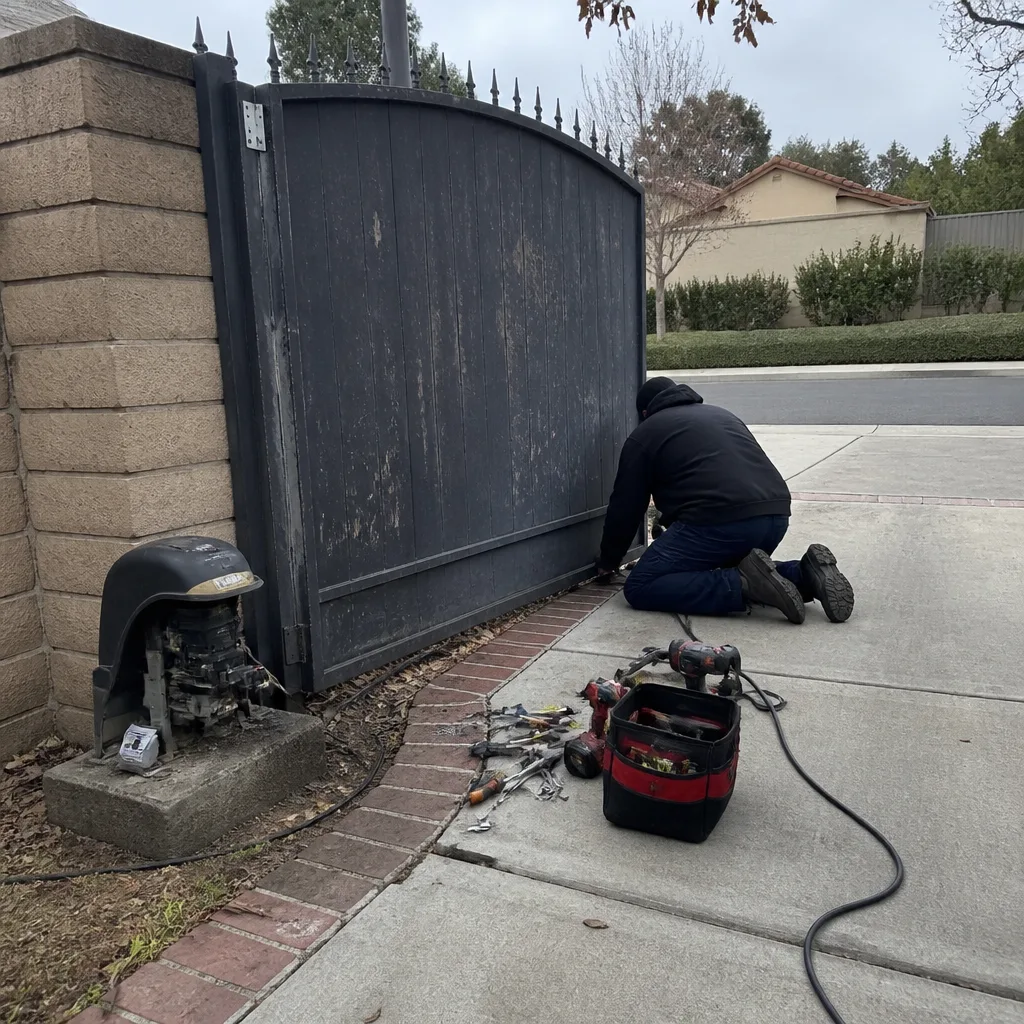 Before
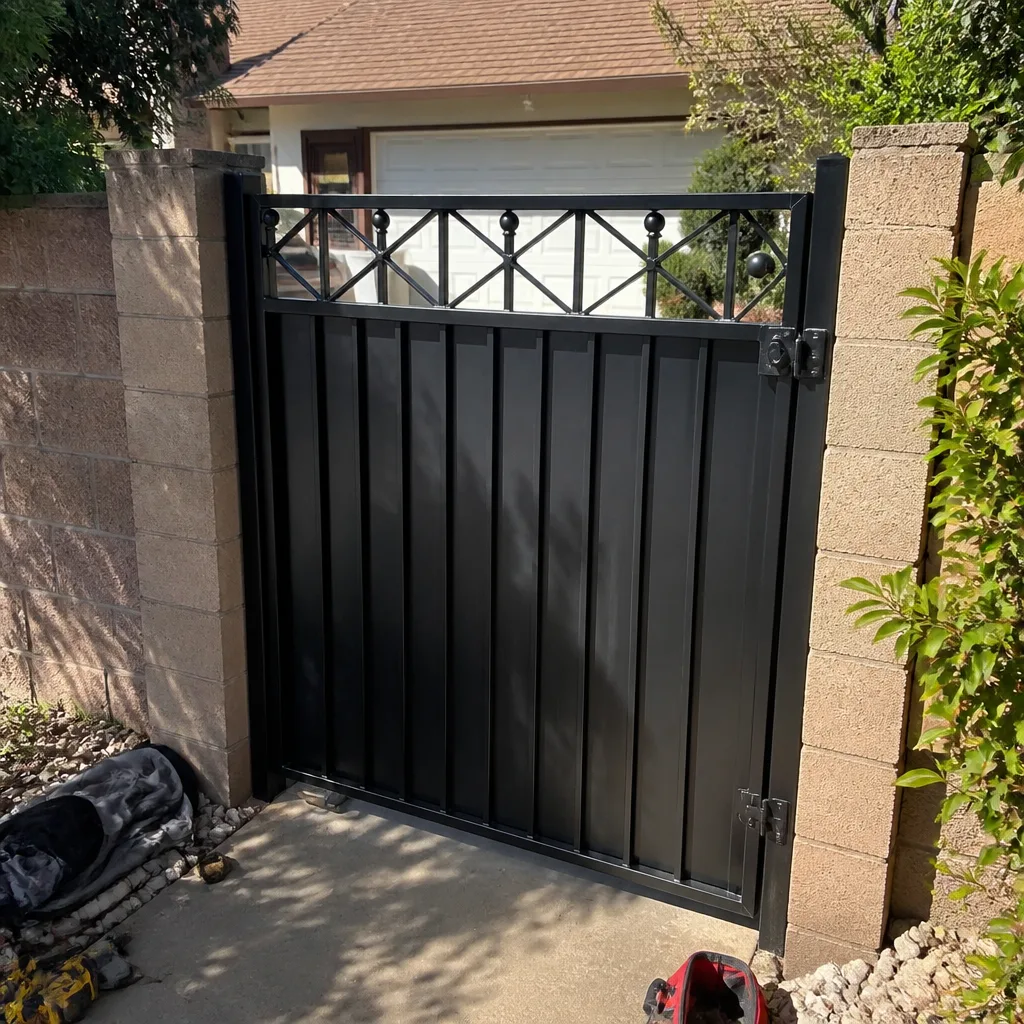 After
After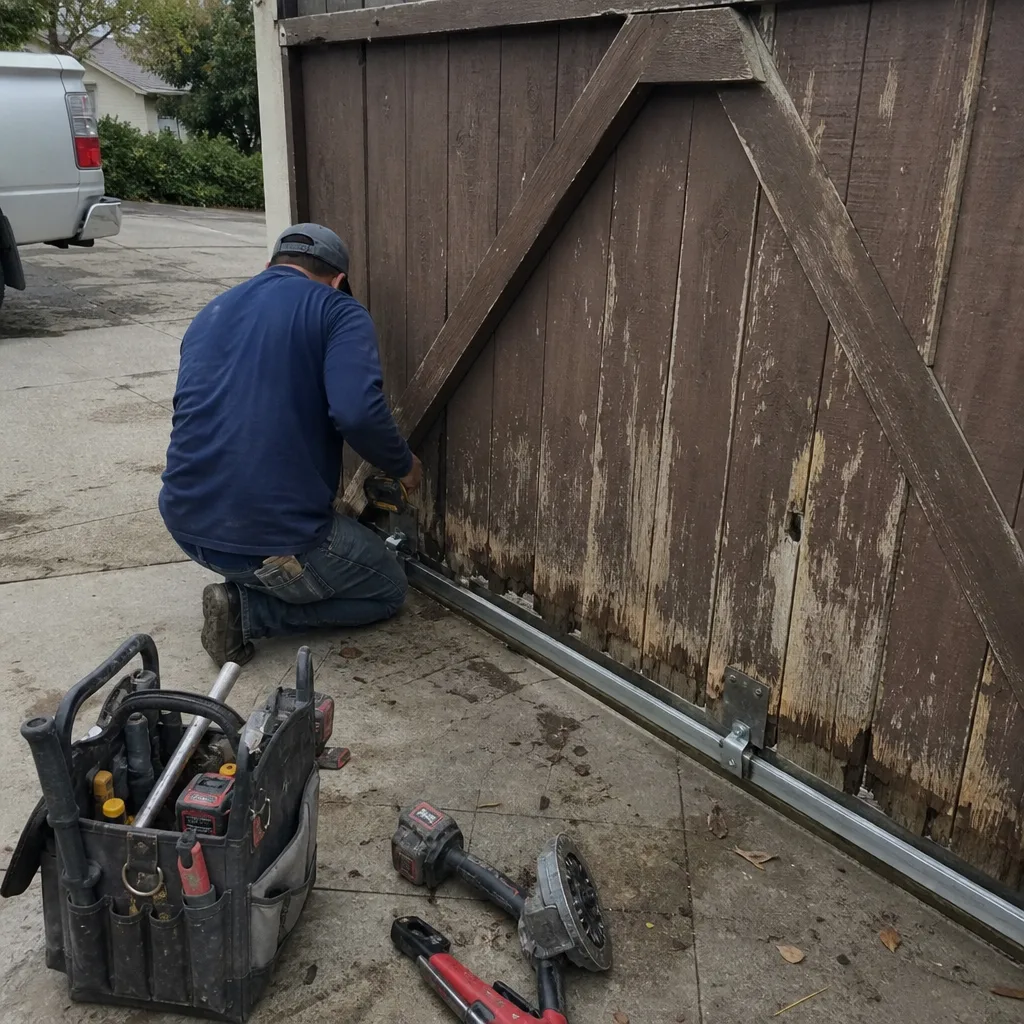 Before
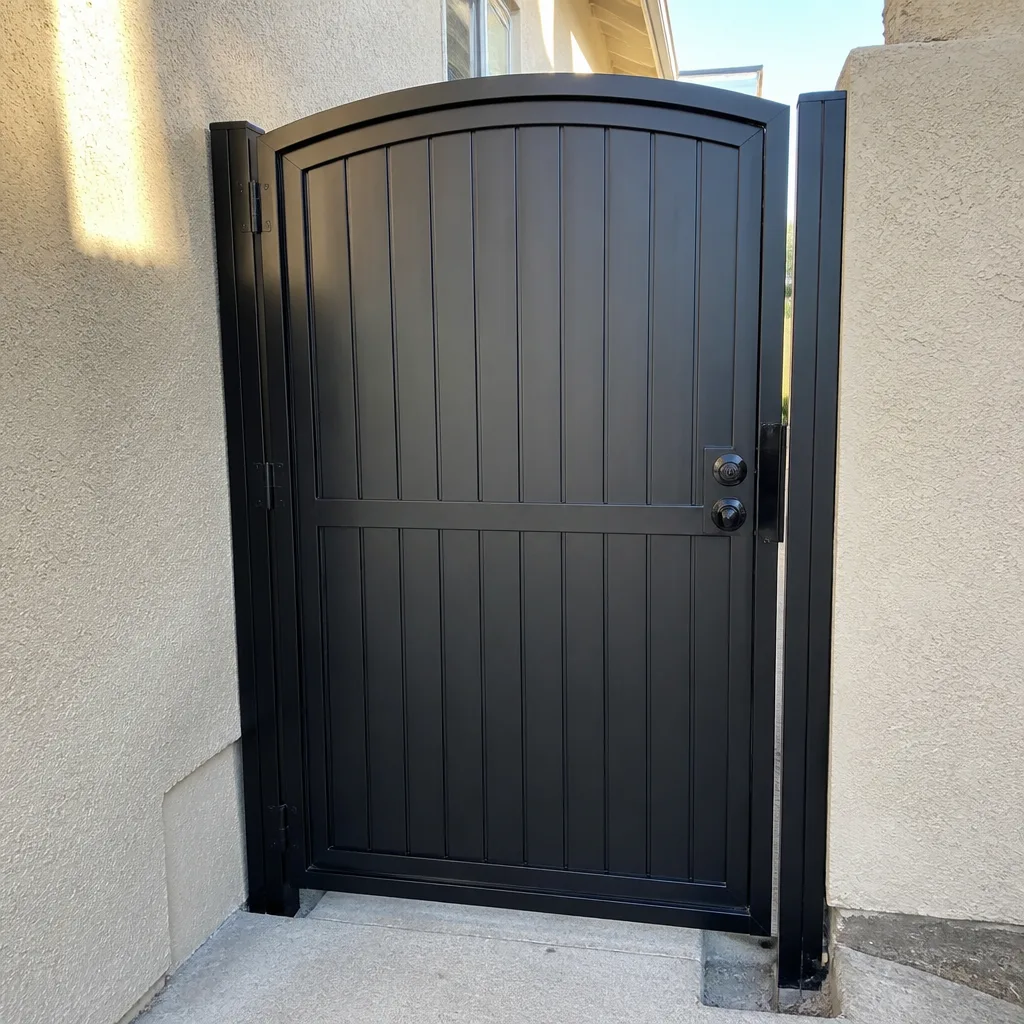 After
After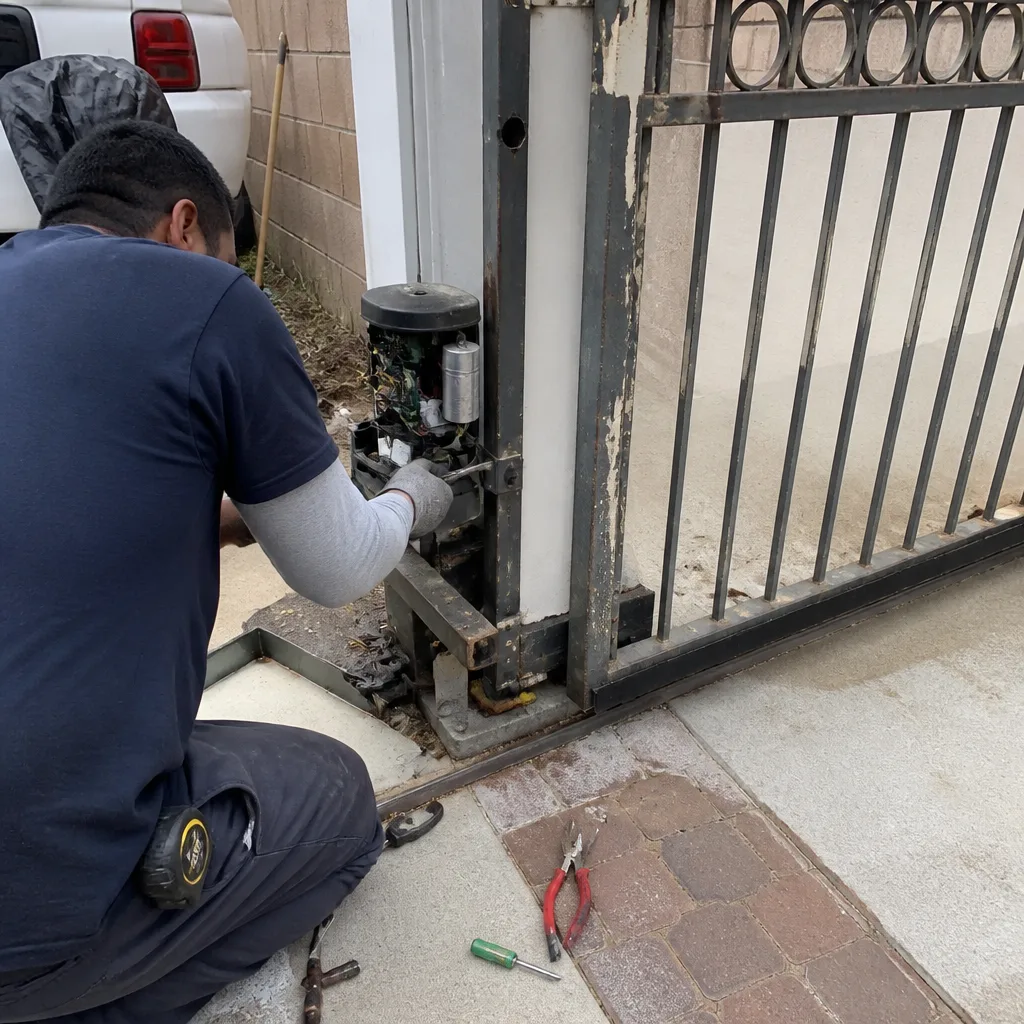 Before
 After
AfterGate Repair Warning Signs: A Simi Valley Homeowner’s Reference Guide
A gate that hesitates one second longer than it used to before moving is already telling you something, either a capacitor is degrading, a limit switch has drifted, or the operator is working harder than its design load. Most homeowners in Simi Valley call it “a little slow” and wait until it stops entirely. This guide walks you through what that hesitation means, which warning signs you can spot from the driveway, and when to call our Gate Repair services for what only a trained eye can see. By the time you finish, you’ll know what to watch for, what to record, and when a repair should move from your mental list to a phone call.
Quick Answer
Gate failure signs split into two types: visible symptoms you can see and hear, and electrical symptoms that hide inside the operator and control board. The electrical signs almost always appear first, sometimes weeks or months before the gate stops moving. In Simi Valley, the most common first warnings are a slower-than-normal gate cycle, a remote that works only at close range, and a motor that hums but doesn’t immediately move. If you notice any one of these, document what you observed and call a gate technician before the gate quits at the worst possible moment, which is usually when you’re late and the opener has finally given up.
Table of Contents
- Visible Symptoms: What You Can See and Hear From the Driveway
- Electrical Symptoms: The Warnings That Appear Before Anything Breaks
- Symptom-to-Cause Index: What Each Sign Points To
- Simi Valley-Specific Warning Signs: Heat, Dust, and UV Exposure
- How to Distinguish Operator Failure From Control Board Failure From Loop Detector Problems
- Scheduled Appointment or Same-Week Service: How to Decide
- How to Document a Warning Sign So the Diagnosis Starts in the Right Place
- Common Mistakes to Avoid
- When to Call a Professional
- Frequently Asked Questions
- The Bottom Line
BeforeAfterVisible Symptoms: What You Can See and Hear From the Driveway
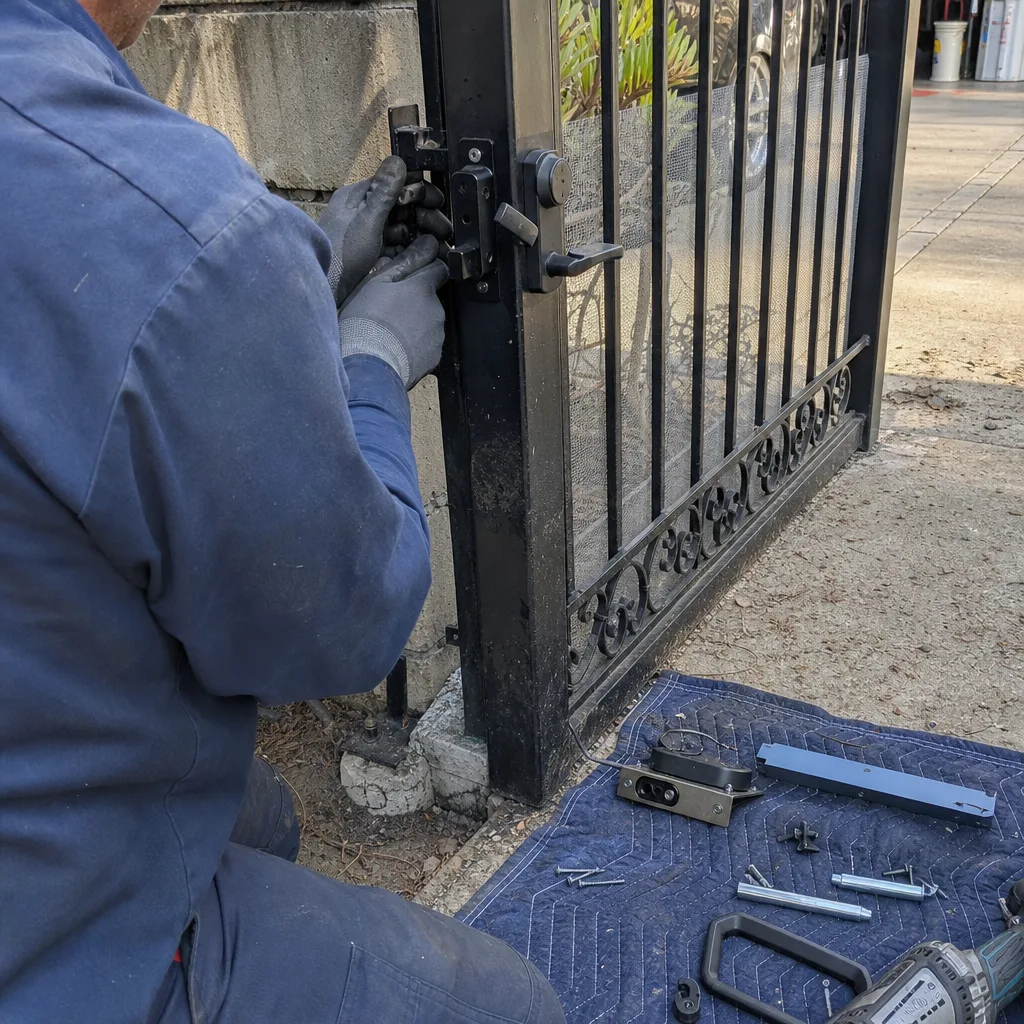
Visible symptoms are the ones you notice without opening a single panel. They’re the gate’s way of telling you something is off before it becomes a full failure, and they’re the easiest to document because they don’t require tools or technical knowledge. The key is knowing which ones matter and which ones you can safely watch for a week or two.
The gate hesitates before moving
A gate that pauses for a beat or two after you press the remote is showing you a capacitor that’s losing its ability to deliver the starting voltage. The motor needs a jolt of stored energy to overcome inertia, and a degraded capacitor delivers a weaker jolt. It’s one of the earliest signs of operator wear. You’ll notice it most on cold mornings, which Simi Valley gets more of than people expect, especially in the winter months when overnight temperatures drop into the low 40s. If the hesitation lasts longer than two seconds, the capacitor is likely near the end of its service life.
The gate moves slower than it used to
Speed loss is almost never a motor problem by itself. In most cases, the gate’s rolling resistance has increased, which means the wheels are wearing, the track has accumulated debris, or a hinge has started to bind. The motor is working harder to move the same weight, and the slowdown is the result. A gate that used to open in 12 seconds and now takes 18 is drawing more current through the operator, which accelerates wear on every electrical component downstream. In our experience across Simi Valley, this is the single most common sign homeowners report after the gate has already stopped, they just didn’t recognize it as a warning at the time.
The gate reverses for no visible reason
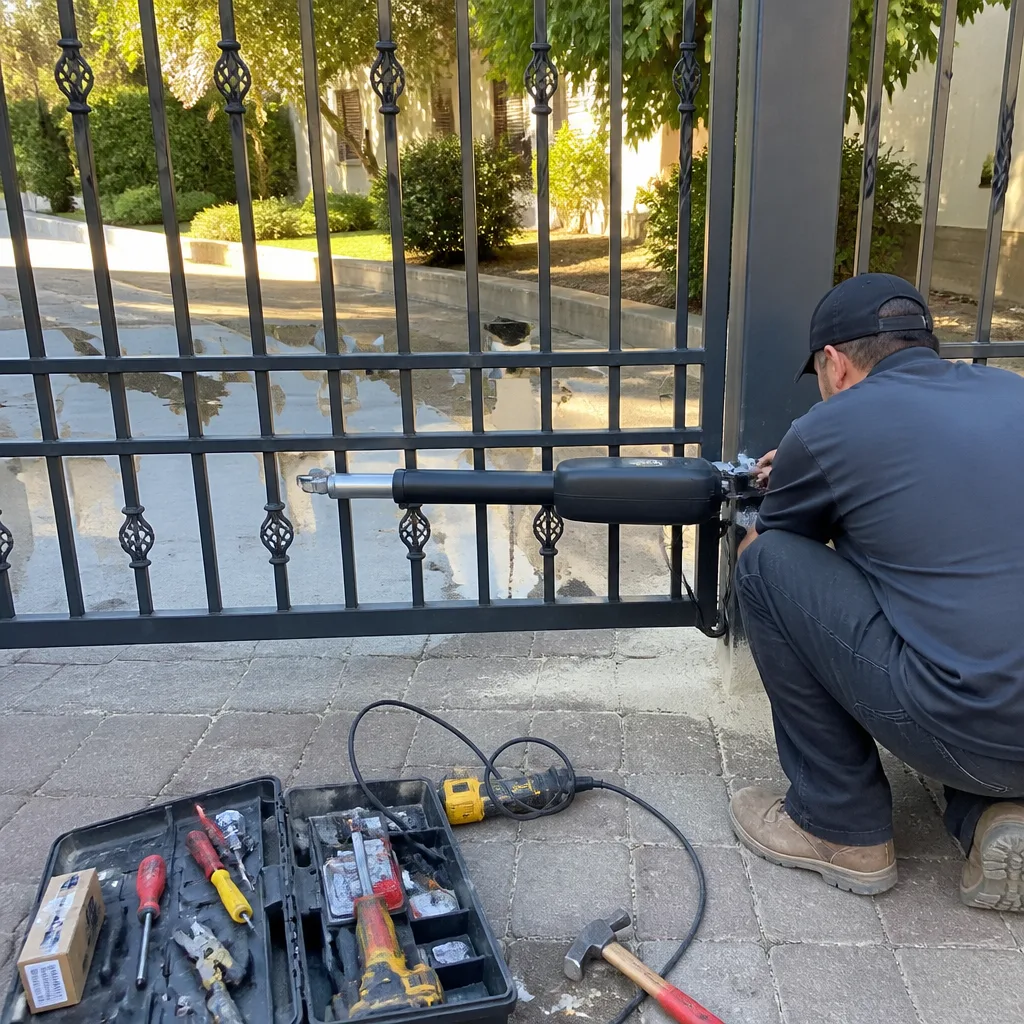
A phantom reversal happens when the gate starts closing, then stops and reverses as if something were in the way. The usual cause is a misaligned photo-eye, the infrared beam that sits on each side of the gate opening and stops the gate if anything crosses the path. A photo-eye off by even two inches will trigger false reversals. But there’s a second cause that’s more concerning: a worn-out limit switch that’s telling the control board the gate has traveled farther than it actually has. When the board receives conflicting signals, it defaults to safety and reverses the gate. If realigning the photo-eyes doesn’t fix it, the limit switch is the next suspect.
The remote only works at close range
Remote range drop is one of the most commonly ignored warning signs because it’s easy to explain away: dead battery, wrong angle, interference. But if you’ve replaced the battery and you’re still holding the remote against the gate to get it to move, the receiver antenna on the operator has likely degraded. Sun exposure, heat cycles, and simple age all take their toll on the antenna and the receiver board. In Simi Valley, where summer temperatures routinely climb past 95 degrees, antennas degrade faster than they do in cooler climates. A range drop from 50 feet to 15 feet is a real symptom, not a battery problem.
You hear a new sound: grinding, clicking, humming
New sounds are always diagnostic. Grinding usually means metal-on-metal contact, often a wheel bearing that’s given up or a gear that’s missing teeth. Clicking is typically a starter capacitor trying and failing to engage, or a relay chattering inside the control board. A motor that hums but doesn’t move is the most urgent sound of all: the motor is receiving power but can’t turn, which means the capacitor has failed, the drive gear is stripped, or something is physically jamming the gate. Continued attempts to run a humming motor will overheat it and turn a $400 repair into a $1,800 operator replacement.
Electrical Symptoms: The Warnings That Appear Before Anything Breaks
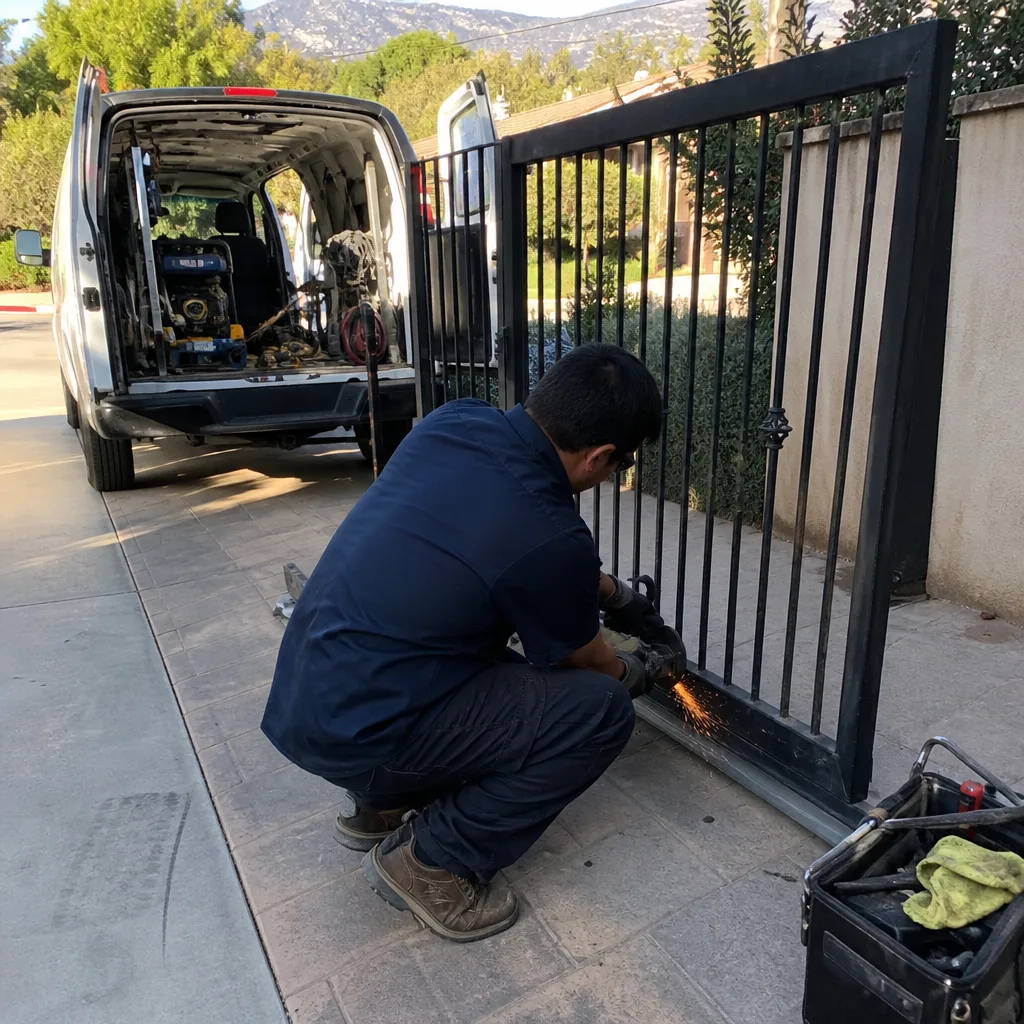
Electrical symptoms are the ones you can’t see from the driveway. They live inside the operator housing, on the control board, and in the wiring that connects everything together. These are the warnings that appear first, often months before the gate stops moving, and they’re the reason a homeowner who waits for a visible symptom is always behind the curve. The electrical signs are subtle, but they’re observable if you know what you’re looking at.
Capacitor degradation: the quiet countdown
The capacitor is the electrical component that gives the motor its starting kick. Capacitors in gate operators typically last 5 to 8 years, depending on the number of cycles per day and the ambient temperature. In Simi Valley, where summer heat bakes operator housings to over 130 degrees on a July afternoon, capacitors age faster than the manufacturer’s spec sheet suggests. The first sign of a failing capacitor is a slight delay between the relay click and the motor starting. The second is a slower start. The third is a motor that hums and doesn’t move. Each stage takes weeks, which means you have time to act if you recognize the first stage for what it is.
Limit switch drift
The limit switch tells the control board where the gate should stop. Over time, vibration, temperature swings, and the normal wear of mechanical components cause the limit switch to drift from its original setting. The first sign is a gate that opens to slightly different positions each time: sometimes fully open, sometimes a few inches short. The second sign is a gate that doesn’t fully close, leaving a gap that’s easy to miss from the car. A drifted limit switch is a safety issue and a security issue, and it’s not something to put off. We’ve seen limit switches in Simi Valley drift from their settings by as much as 15 degrees, usually on gates that were installed without proper thermal expansion allowances in the mounting hardware.
Wire insulation failure from UV exposure
Simi Valley gets an average of 277 sunny days per year, and all that sunlight is hard on wire insulation. Low-voltage wiring that runs from the operator to the photo-eyes, the keypad, and the loop detectors is usually rated for UV exposure, but ratings fade with time. The first sign of UV-cracked insulation is intermittent operation: the gate works, then it doesn’t, then it works again. The second sign is visible cracking on any exposed wiring runs. If you can see cracks in the wire jacket, the conductor inside is already exposed to moisture and corrosion. This is a repair that’s cheap if caught early and expensive if the corrosion works its way back into the control board.
Battery backup swelling or leaking
Many gate operators in Simi Valley are equipped with battery backup systems, and a failing battery gives off clear signs that are easy to miss unless you open the operator housing. A swollen battery case means the internal cells have degraded and are producing gas. A leaking battery will leave visible residue on the battery shelf and will sometimes produce a faint chemical smell. A battery that won’t hold a charge after a power cycle is the final stage. Any of these signs means the battery should be replaced before it damages the control board it’s sitting next to.
Relay chatter and intermittent function
A relay is a small electromechanical switch inside the control board that routes power to the motor. When a relay starts to fail, it doesn’t fail silently. It chatters, which sounds like a rapid clicking from inside the operator housing. Homeowners sometimes describe it as “the gate sounds like it’s stuttering.” Relay chatter is a sign that the relay contacts are pitted or the coil is failing, and it’s a warning that the control board is headed for failure. Catching a chattering relay early is often the difference between a $40 relay replacement and a $600 control board replacement.
Symptom-to-Cause Index: What Each Sign Points To
If you’ve noticed a warning sign and want to know what it means, this index maps each observable symptom to its most probable causes. This is the same mental model our technicians in Simi Valley use on the drive out to a job, and it works well enough for homeowners to use as a starting point before calling anyone.
Symptom: Gate hesitates before moving
- Most likely: Capacitor degradation (age, heat exposure)
- Also possible: Worn drive gear or belt beginning to slip
- Less likely but possible: Control board relay contact wear
Symptom: Gate moves slower than normal
- Most likely: Increased rolling resistance (worn wheels, debris in track)
- Also possible: Hinge binding from lack of lubrication or misalignment
- Less likely but possible: Motor winding degradation from repeated overheating
Symptom: Gate reverses without anything in the way
- Most likely: Misaligned photo-eye (infrared beam off by more than an inch or two)
- Also possible: Limit switch drift sending a false over-travel signal
- Less likely but possible: Loop detector sensing phantom vehicle presence
Symptom: Remote range drops sharply
- Most likely: Receiver antenna degradation (UV and heat exposure)
- Also possible: Remote battery at end of life (replace first; it’s the cheapest variable)
- Less likely but possible: New nearby radio interference (CCTV cameras, mesh Wi-Fi, solar inverters)
Symptom: Gate drifts after stopping
- Most likely: Worn limit switch or limit-switch mounting hardware
- Also possible: Gearbox wear allowing the gate to move under its own weight
- Less likely but possible: Hydraulic leak in a hydraulic operator (rare in residential Simi Valley gates, but we see it in older Viking and BFT units)
Symptom: Motor hums but gate doesn’t move
- Most likely: Failed capacitor delivering no starting torque
- Also possible: Stripped drive gear or broken belt
- Less likely but possible: Mechanical bind in the gate itself (a wheel has seized or a post has shifted)
Simi Valley-Specific Warning Signs: Heat, Dust, and UV Exposure
Every climate creates its own failure patterns, and Simi Valley’s is a combination of extreme summer heat, dry air, dust from the surrounding foothills, and intense UV exposure covered in Seasonal Gate Repair Care for Simi Valley: Year-Round Homeowner’s Guide. These aren’t generic gate problems that happen everywhere. They’re specific to what your gate experiences at the 34th parallel north, 100 feet above sea level, with the Santa Susana Mountains to the north and the Simi Hills to the south.
Heat haze on the control board housing
If the plastic or metal housing over the control board looks wavy, foggy, or discolored, that’s heat damage. Controller housings in Simi Valley regularly exceed 130 degrees on summer afternoons, especially on south-facing installations without shade. Heat haze on the housing is a warning that the control board inside has been operating above its rated temperature for a long time. The board itself may still function, but its capacitors, relays, and solder joints have been cooking. This is a sign we look for immediately on any service call to a south-facing gate in Simi Valley during the summer months.
Dust accumulation in operator vents: the “raspy start” sound
The dry air and consistent wind in Simi Valley mean fine dust works its way into everything, including the operator housing. When enough dust accumulates on the cooling vents and the internal fan, the operator runs hot, and the fan develops a distinct raspy sound on startup. It’s different from a clicking relay, more like sandpaper being dragged across a hard surface, and it goes away after a few seconds. If you hear this sound, the inside of the operator is dusted enough that ventilation is impaired. A simple cleaning can extend the life of the operator by years, but ignored, the accumulated dust acts like insulation and pushes internal temperatures past component ratings.
UV-cracked wiring insulation on exposed runs
Simi Valley’s 277 days of annual sunshine break down wire insulation faster than almost anywhere in California except the high desert. The first visible sign is a chalky, whitish appearance on the wire jacket. The second is fine cracks, often running lengthwise along the wire. The third is exposed conductor, which is past the warning stage. If you see any exposed wiring on your gate, even if the gate is still working, that’s a same-week service item. Moisture penetration into the conductor will eventually follow the wire back into the control board, and a control board that takes on moisture corrosion is a much more expensive repair than a section of rewiring.
Warped operator cover from thermal cycling
When a plastic operator cover goes through enough heat-cool cycles, it warps. The cover doesn’t seat properly, dirt and moisture get in easier, and the mounting screws lose tension. A warped cover is a warning sign that the operator internals have been exposed to thermal stress for years. It’s also the first thing a technician notices when opening the housing, and it’s usually accompanied by other heat-related wear inside. We’ve replaced enough heat-damaged FAAC and BFT boards in Simi Valley to immediately associate a warped cover with a board that’s been running hot.
How to Distinguish Operator Failure From Control Board Failure From Loop Detector Problems
Three of the most common failure points in a gate automation system are the operator (the motor and gearbox), the control board (the brain), and the loop detector (the sensor that detects a vehicle sitting above the underground loop). Each produces a different signature, and a homeowner can often identify which one is failing using only observation. Here’s how.
Operator failure signature
- The gate moves, but it moves badly: slow, jerky, grinding, or not at all when the motor hums.
- The remote and keypad both trigger the gate, and the control board responds, but the mechanical movement is where the problem shows up.
- Common operator failures: worn gears, broken belts, failed capacitors, seized wheel bearings, burned motor windings.
Control board failure signature
- The gate doesn’t respond at all to the remote, keypad, or hardwired open button, or it responds intermittently with relay chatter.
- Some functions work while others don’t: the remote opens the gate, but the auto-close timer stopped working, or the gate opens but won’t close.
- Multiple unrelated symptoms appear at the same time with no mechanical explanation.
- Common control board failures: pitted relay contacts, thermal cracks in solder joints, capacitor failure on the board itself, moisture corrosion, heat damage.
Loop detector failure signature
- The gate fails to open for a vehicle but opens fine for the remote and keypad.
- The gate opens for a vehicle but then won’t close afterward, because the loop detector thinks the vehicle is still there.
- The gate behaves normally for motorcycles or small cars but not for larger vehicles, a sign the loop sensitivity is set incorrectly.
- Common loop detector failures: a break in the underground loop wire, a mis-set sensitivity dial, or a detector board that’s failed after years of heat exposure.
These three failure modes overlap more than the index suggests, and a definitive diagnosis often requires opening the operator and testing with a multimeter. But knowing which signature your gate is showing helps you describe the problem to a technician in terms that point the diagnosis in the right direction before they arrive, as explained in How to Hire a Gate Repair Contractor in Simi Valley: A Step-by-Step Guide. If you tell us “the gate opens with the remote but won’t open for the car,” we already know to bring a loop tester. If you tell us “the motor hums but the gate won’t move,” we’re bringing a capacitor and a gear set. That’s the difference between a one-trip repair and a two-trip repair.
Scheduled Appointment or Same-Week Service: How to Decide
Not every warning sign requires immediate attention. Some can wait a week or two. Others shouldn’t wait at all. Here’s how to sort them.
Signs that can wait for a scheduled appointment
- Remote range drop with no other symptoms. If the gate still opens and closes reliably with the remote held at close range, the antenna or battery issue can be diagnosed at a regular appointment. Replace the remote battery first to rule out the cheap fix.
- Slow movement with no new sounds. A gradual slowdown over weeks, with no grinding or clicking, suggests rolling resistance rather than an active failure. It’s a maintenance item, not a breakdown-in-progress.
- Visible wire insulation cracking with no malfunction. If the gate works normally and you’ve spotted chalky or cracking wire jackets, that’s a scheduled repair. It becomes urgent the moment symptoms appear.
- Exterior rust on hinges or brackets. Surface rust is a scheduling item. Structural rust through a hinge pin or bracket is an urgent one, but you’ll see the difference.
Signs that warrant same-week service
- Motor hums but gate doesn’t move. Continued attempts to run a stalled motor will destroy the windings. This one becomes more expensive every day it’s ignored.
- Gate reverses for no visible reason and realigning the photo-eyes doesn’t fix it. Phantom reversals with no mechanical cause point to a limit switch or control board problem, and those tend to cascade.
- New grinding or clicking sounds that started suddenly. A sudden new sound is a component actively failing. If metal is grinding, the component is being destroyed every time the gate cycles.
- Gate drifts after stopping or won’t stay in the closed position. A gate that won’t stay closed is a security failure. A gate that drifts when it should be stopped is a safety failure.
- Any electrical smell, smoke, or visible scorching on the operator housing. This is a fire hazard and a same-day call.
In general, if the gate still does its job despite the symptom, schedule it. If the symptom is interfering with the gate’s function or indicating an active failure, move it up. And if you’re unsure which category your symptom falls into, call and describe it. A live person answers our phone at (805) 516-0479 24 hours a day, and the worst-case outcome of the call is a clearer picture of what you’re dealing with.
How to Document a Warning Sign So the Diagnosis Starts in the Right Place
The single most useful thing a homeowner can do after noticing a warning sign is to record what happened, when it happened, and what the gate did immediately afterward. This doesn’t require any technical skill. It requires a phone camera and a note-taking habit, and it can save a technician an hour of guesswork, which saves you money on the service call.
Here’s the format we recommend, and it’s the same format our technicians in Simi Valley use when they open a work order:
- Date and time of the observation. Exact as you can be. “Tuesday morning, around 8:15” is fine. If it’s temperature-related, the time of day matters.
- What you did. “Pressed the remote from inside the car, about 40 feet from the gate.” Or “punched in the keypad code standing at the keypad.”
- What the gate did. “Hesitated for about 2 seconds, then opened at what seemed like half speed.” Or “opened fully, then reversed immediately and stopped mid-open.”
- What you did next. “Pressed the remote again. Same hesitation, same slow open.” Or “waited 30 seconds, pressed the remote again, gate responded normally.”
- Photo or video. A 15-second video of the gate cycling through the abnormal behavior is worth more than a paragraph of description. If the gate is making a sound, capture the sound. If there’s visible damage, get a photo at the closest distance you can safely reach.
Record this even if you don’t have an appointment scheduled yet. The pattern that emerges from two or three documented observations tells a much clearer story than a single episode. A gate that hesitates once a week is a different problem from a gate that hesitates every cycle, and the pattern is visible in the log. It also gives the technician a baseline: if the documented symptoms started two weeks ago and got worse, that’s a different diagnosis path than a symptom that started yesterday and has stayed constant.
We file every documented observation with the job record, and under Clause 4 of the Haven Standard (Evidence on every job), you get a photo log of what we found, what we adjusted, and what we installed. Your documentation starts the trail. Ours completes it.
Common Mistakes to Avoid
- Replacing the remote battery and ignoring the symptom. If a new battery doesn’t restore the range, the remote isn’t the problem. A lot of Simi Valley homeowners burn through two or three batteries before realizing the receiver antenna has failed.
- Lubricating the track without cleaning it first. Spraying lubricant onto a dirty track creates a paste that accelerates wear and attracts more dust. Clean first, then lubricate, and use a dry lubricant rather than oil in Simi Valley’s dusty conditions.
- Waiting for the gate to fail visibly before calling. The electrical warnings appear first, and by the time a mechanical symptom shows up, the electrical problem has already done its damage. A gate that’s slowing down has likely been degrading for months.
- Attempting to adjust limit switches without documentation. Limit switches are calibrated to the specific gate and operator combination. A homeowner who adjusts the limit switch to “fix” a gap problem usually creates a new problem, and without a photo record of the original position, the technician has to recalibrate from scratch.
- Ignoring a phantom reversal after realigning the photo-eyes yourself. If the photo-eyes are aligned and the gate still reverses, the problem is in the limit switch or the control board. Continuing to run the gate in this state will eventually damage the board or the motor.
- Using the gate as a dog run or laundry rack. This is more common in Simi Valley than you’d expect. A Gate Motor or Opener has a duty cycle rating, and every extra cycle from manually pushing the gate while a child or dog hangs on it stresses components that aren’t designed for that load. The warning signs from this kind of use are usually subtle, until they aren’t.
- Replacing what broke instead of what caused the break. A stripped gear is a result, not a cause. The cause was likely high resistance from a neglected track or bad wheel, and a new gear on top of the same resistance will strip again. We see this pattern repeatedly when we follow up on previous repairs from companies that replaced a part and didn’t correct the mechanical issue behind it.
When to Call a Professional
Call a professional when the gate is showing any symptom that interferes with its function, when it’s making a sound you’ve never heard before, or when it’s behaving differently than it did a month ago and the change is getting worse. If you’ve documented the symptom and it’s progressed across two or three observations, that’s a clear signal. If you haven’t documented it and you’re not sure what you’re seeing, call anyway, and describe what you saw. We’d rather spend five minutes on the phone with a homeowner who describes a symptom that turns out to be minor than have them wait until the gate fails completely. Vance Gate Repair Simi Valley home offers free estimates in Simi Valley, and the written price you receive before any work starts means you can get a diagnosis without committing to a repair you haven’t seen in writing. Call (805) 516-0479 and talk to a live person, 24/7. If you’d like a deeper look at the full range of services, start with Gate Repair in Simi Valley for the repair-specific details.
Frequently Asked Questions
Gate repair in Simi Valley typically runs between $180 and $650 for common repairs like capacitor replacement, photo-eye realignment, limit switch adjustment, and remote programming. More involved jobs, like a full Gate Motor & Opener replacement, run $850 to $2,400 depending on the brand and whether the arm bracket and mounting hardware are intact. The written price is always delivered before any work starts, and under Clause 1 of the Haven Standard, you’ll see the number on paper before a tool is picked up. Call (805) 516-0479 for an exact quote on your specific gate, estimates are free.
That’s the signature of a loop detector failure, the sensor that detects a vehicle sitting above the underground loop wire. The remote and keypad work because they send a signal directly to the control board, while the loop detector is a separate input that’s not seeing your vehicle. Call (805) 516-0479 and describe the symptom in those exact words, and you’ll save the technician a diagnostic step.
For emergencies like a gate stuck open or a motor that’s humming but not moving, same-day dispatch is available in Simi Valley. A live person answers at (805) 516-0479 at any hour, and they’ll tell you what the next available service window is, not a callback queue. For non-emergency warning signs, same-week scheduling is standard.
A full Gate Installation in Simi Valley from Vance Gate Repair includes the gate fabrication or order, posts set in concrete to the depth required for Simi Valley’s soil conditions, the operator and arm or slide track, photo-eyes, keypad, loop detector installation, and the full wiring run to power. Every installation is priced in writing before any work starts, and the documentation you receive includes a photo log of the completed work and wiring diagrams for future service. Estimates for installation are free, and you’ll get a written proposal, not a verbal number.
No. A grinding sound means metal is being removed from a component every time the gate cycles, and every additional cycle makes the repair more expensive. The gate may still function, but the component that’s grinding is being destroyed in real time. Stop using the gate and call (805) 516-0479 for a diagnosis. If the gate must be used to get a vehicle out, use it the minimum number of times necessary until a technician arrives.
It means the motor is receiving power but can’t turn, usually because the starting capacitor has failed, the drive gear is stripped, or something is physically jamming the gate. Do not keep pressing the remote. Each attempt sends a surge of current through the stalled motor and shortens its remaining life. This is a same-day emergency in most cases, and the longer it’s left in that state, the more likely the repair becomes a full operator replacement.
The Bottom Line
The gate in your driveway is speaking to you, and most of what it says comes before anything actually breaks. The electrical signs, a slower start, a weaker remote signal, a relay that chatters, a limit switch that drifts, appear first. The mechanical signs, a gate that stops opening, come later, after the electrical problem has already done its work. The homeowners in Simi Valley who catch the early signs and act on them are the ones who pay for a $200 capacitor replacement instead of a $1,800 operator. Document what you see, describe it accurately when you call, and get a written price before anyone picks up a tool. For more guides & resources, explore our blog. That’s the whole system, and it works.
Written by Adrian Vance, Owner at Vance Gate Repair Simi Valley, serving Simi Valley since 2014.